
New Publication: Review of Floating Offshore Wind Turbines with Shared Mooring Systems in JMSE
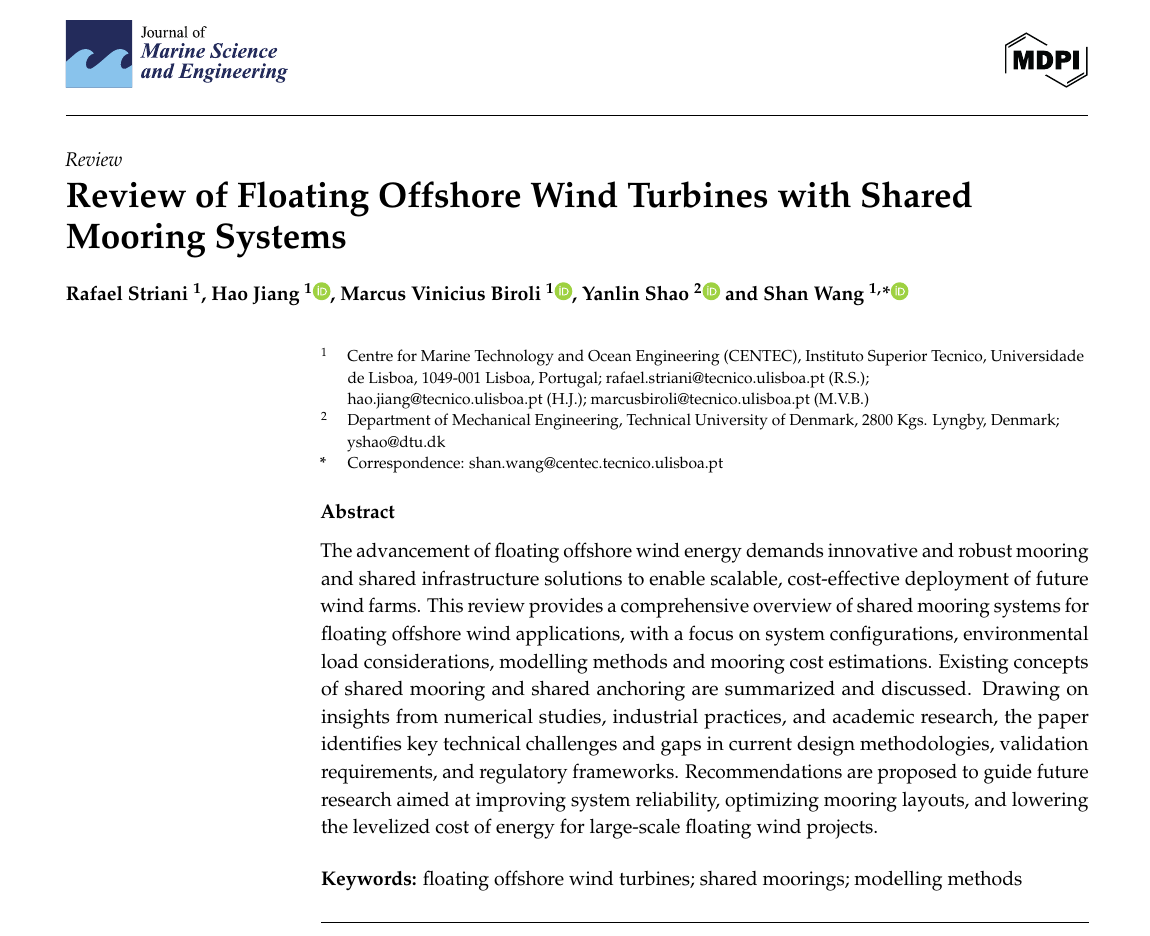
A review journal article on floating offshore wind turbines with shared mooring systems has been recently published in the Journal of Marine Science and Engineering.
This article is a collaborative effort between researchers at IST-ID and DTU, including Rafael Striani, Hao Jiang, Marcus Vinicius Biroli, and Yanlin Shao. The paper’s corresponding author is Shan Wang (IST-ID), who also serves as the WP3 leader for the ESOMOOR project.
Overview
As the offshore wind industry expands into deeper waters, floating offshore wind turbines (FOWTs) are becoming increasingly vital; however, high capital (CAPEX) and operational (OPEX) expenditures remain a barrier to large-scale commercialization. Currently, the Levelized Cost of Energy (LCOE) for floating wind is significantly higher than for fixed-bottom structures. To address this, shared mooring systems have emerged as a promising solution to optimize load distribution, reduce the number of anchors and lines, and lower overall system costs.
Key Contributions
This newly published review provides a comprehensive overview of shared mooring systems for floating offshore wind applications. The paper summarizes existing concepts of shared mooring and shared anchoring, drawing insights from numerical studies, industrial practices, and academic research.
Key topics covered in the article include:
- System Configurations: A detailed look at catenary, taut-leg, and semi-taut configurations, as well as the differences between shared-line and shared-anchor layouts.
- Modelling Methods: An evaluation of low- to high-fidelity modelling tools (from quasi-static to coupled CFD-FEM), highlighting the need for advanced methods to capture hydrodynamic coupling and snap loads in shared arrays.
- Cost Estimation: A critical analysis of cost drivers, revealing that while shared lines can significantly reduce CAPEX by minimizing components, the economic benefits of shared anchors are more complex and depend on scale and failure risks.
Future Directions
The review identifies technical challenges such as the complex dynamics introduced by coupling turbines and the occurrence of snap loads. It proposes recommendations for future research aimed at improving system reliability, optimizing mooring layouts through the use of clump weights and stiffer lines, and ultimately lowering the LCOE for large-scale floating wind projects.
Read the full open access article here: Review of Floating Offshore Wind Turbines with Shared Mooring Systems
Acknowledgments This work has been supported by the project “Enhancing shared mooring system design for floating offshore wind farms (ESOMOOR)”, funded by the Portuguese Foundation for Science and Technology, Innovation Fund Denmark and co-funded by the European Union.